

In today’s digital world, your website is often the first impression potential customers have of your business. A well-designed website should not only be functional and visually appealing but also effectively communicate your brand identity.
Your brand identity consists of elements like your logo, colors, typography, messaging, and overall style, which set you apart from competitors. When your website aligns with these elements, it helps build trust, recognition, and consistency across all customer interactions.
In this guide, we’ll explore how to design a website that truly reflects your brand identity and leaves a lasting impact on your visitors.
1. Understand Your Brand Identity
Before you start designing, you need to have a clear understanding of your brand identity. Ask yourself:
- What are my brand values? (e.g., innovation, reliability, affordability)
- Who is my target audience? (e.g., young professionals, business owners, students)
- What emotions should my brand evoke? (e.g., trust, excitement, luxury)
- What is my unique selling point (USP)? (e.g., fastest delivery, best customer service, eco-friendliness)
Defining these aspects will help ensure your website communicates the right message and connects with the right audience.

2. Choose the Right Color Palette
Colors play a crucial role in branding and user perception. Your website’s color scheme should align with your brand colors and evoke the right emotions.
- Red – Represents passion, energy, and urgency (e.g., Coca-Cola, YouTube).
- Blue – Symbolizes trust, professionalism, and reliability (e.g., Facebook, LinkedIn).
- Green – Associated with growth, sustainability, and freshness (e.g., WhatsApp, Starbucks).
- Yellow – Conveys optimism, friendliness, and warmth (e.g., McDonald’s, Snapchat).
If you already have a brand logo and marketing materials, ensure your website follows the same color scheme for consistency. Use primary brand colors for headlines and important elements, and secondary colors for accents.
3. Use Typography That Matches Your Brand Personality
Fonts and typography style contribute to the look and feel of your website. Choose fonts that complement your brand’s personality:
- Modern & Techy – Sans-serif fonts like Poppins, Roboto, or Montserrat.
- Elegant & Luxurious – Serif fonts like Playfair Display, Georgia, or Times New Roman.
- Friendly & Fun – Rounded fonts like Nunito or Quicksand.
Make sure fonts are readable on all devices. Use different font weights (bold, regular, light) to create a visual hierarchy, making important information stand out.
4. Create a Strong Logo and Position It Correctly
Your logo is the face of your brand and should be prominently displayed on your website.
- Place your logo in the top left corner (users naturally scan from left to right).
- Use a transparent background logo to blend seamlessly with your website design.
- Ensure the logo is high resolution and scales well on mobile devices.
A recognizable logo helps users associate your website with your brand, increasing trust and credibility.
5. Maintain Consistency Across All Pages
A consistent design ensures that visitors recognize your brand no matter which page they land on. To achieve this:
- Use the same colors and fonts throughout the website.
- Keep button styles, icons, and headings uniform across all pages.
- Maintain consistent tone and messaging in your content.
This consistency makes your website look professional and well-structured, improving user experience and brand recall.
6. Use High-Quality Images and Graphics
Visuals are powerful tools for branding. Use high-quality images, illustrations, and videos that align with your brand identity.
- If you sell products, use clear, professional photos that showcase them well.
- If your brand is service-based, use real team photos to build trust.
- Avoid using generic stock images—they can make your brand feel impersonal.
For custom graphics, consider using motion graphics, icons, or infographics that match your brand’s style.
7. Craft a Brand-Consistent Message
Your website’s content should match your brand’s voice and tone. Whether your brand is formal, friendly, humorous, or authoritative, your website copy should reflect this.
Key Content Elements to Focus On:
- Homepage Headline: Clearly communicate what your brand does in a few words.
- About Page: Tell your brand story in an engaging and relatable way.
- Product/Service Descriptions: Use compelling language to highlight benefits.
- Call-to-Action (CTA): Keep CTA buttons clear and action-oriented (e.g., “Get Started,” “Request a Quote,” “Shop Now”).
Your brand’s personality and values should shine through in every piece of text.
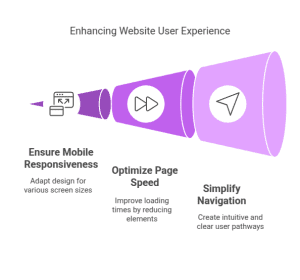
8. Optimize for Mobile and User Experience (UX)
A website that reflects your brand identity should also be user-friendly and accessible on all devices.
- Ensure your website is mobile-responsive (adapts to different screen sizes).
- Use fast-loading pages to prevent users from leaving (optimize images, reduce unnecessary scripts).
- Keep navigation simple and intuitive (use clear menu labels, breadcrumbs, and search functionality).
If users struggle to browse your site, they’ll associate your brand with frustration rather than reliability.
9. Include Trust Elements to Strengthen Credibility
To make your brand more trustworthy, include elements that build credibility:
- Testimonials & Reviews – Display real customer feedback.
- Security Badges – If handling transactions, show SSL certification and payment security icons.
- Awards & Certifications – Showcase any recognitions or partnerships.
- Case Studies & Portfolios – Demonstrate past work or success stories.
Trust signals enhance brand credibility and encourage visitors to take action.
10. Align Your Website with Your Social Media Presence
Your website and social media platforms should work together to create a unified brand experience.
- Add social media icons to the footer or header.
- Use matching profile pictures, banners, and colors across all platforms.
- Embed social media feeds or testimonials to make your website feel more dynamic.
A strong social presence reinforces brand identity and increases customer engagement.
Conclusion
A well-designed website does more than just look good—it tells your brand’s story, builds trust, and attracts the right audience. By focusing on brand consistency, typography, colors, messaging, and user experience, you can create a website that authentically represents your brand and drives business success.
At Techrahisi, we specialize in building custom websites that reflect your brand identity and engage your audience. Whether you need a new website or a redesign, our expert team is here to help.
📞 Call us: +254726572527
📧 Email: developers@techrahisi.co.ke
🌍 Visit: techrahisi.co.ke